
Indiana Jones - Fact or Truth
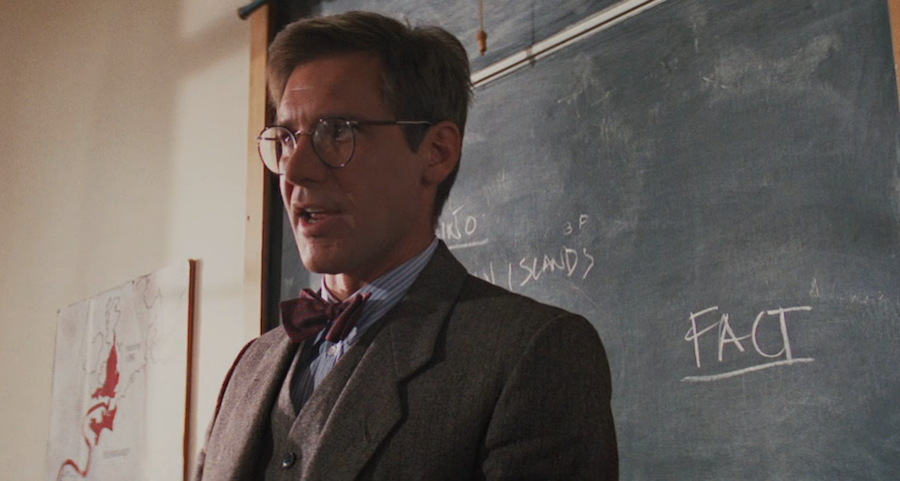
“Archaeology is the search for fact, not truth,” Professor Jones instructs his class during an early scene in Indiana Jones and the Last Crusade. “So forget any ideas you’ve got about lost cities, exotic travel, and digging up the world. We do not follow maps to buried treasure, and X never, ever, marks the spot.” Yet just a few scenes later X does indeed mark the spot as Indy uncovers a hidden passage located at an ancient library. There he discovers the corpse of Sir Richard, a knight from the first crusade. Markings on the knight’s tomb identify a lost city referenced in a map with no names, and eventually Indiana, utilizing that same map, travels through exotic landscapes that lead him to the Holy Grail. As Henry Jones, Sr. says, “You call this archaeology?”
The irony of how this all plays out is not accidental, it begs deeper questions about one of film’s most famous adventurers - what does archaeology truly mean to Indiana Jones, and what is he truly searching for? This contrast between fact versus truth echoes the character of Indy and his adventures. One side is a university professor lecturing that archaeology is done in the library through research, and on the other - globe-trotting adventurer who practically stops at nothing in obtaining whatever ancient artifact he is searching for. A morally decent and yet deeply flawed character, he’s willing to keep a lover captured by Nazis to avoid his own detection. He hesitates to help residents of a poor Indian village until he discovers potential fortune and glory. As rugged, tough and smooth as he may seem, he is also unable to deal with the crushing loss of loved ones, pushing those left behind further away.
Looking at this fact versus truth argument may actually be the heart of Indy’s story, more than the sacred objects he is chasing after. He is a deeper character than most realize, and while he may believe his work is the search for fact, at the heart of each of the five Indiana Jones films is a journey into his own truth within himself.
The Acceptance of Faith
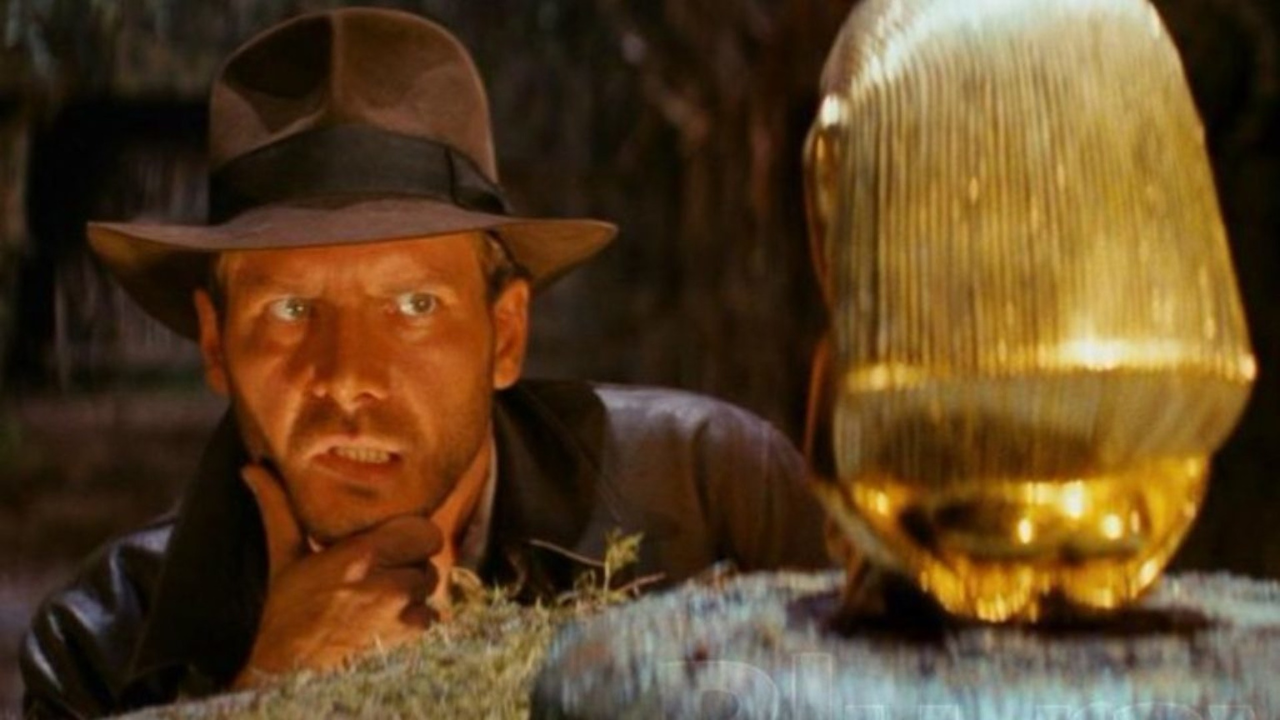
“Archaeology is our religion, but we have both fallen from the pure of faith,” Indiana’s archrival Belloq tells him. Even coming from the villain, this sums up Indy well, particularly in Raiders. He clearly is passionate about archaeology, and he has a clear knowledge of the Ark of the Covenant’s history and the theories of its whereabouts. But he views all of this through a historical and factual lens, with no spiritual or religious connection at all. Early in the film, he describes the Ark’s power to government officials as “lightning, fire, power of god, or something” in an off handed, irreverent manner. He later scoffs at his friend Marcus Brody’s warnings of the Ark’s secrets. “I don’t believe in magic, superstitious hocus-pocus. I’m going after a find of incredible historical significance; you’re talking about the boogeyman.”
But the Ark’s existence surely implies more than just history, and once again it’s Belloq who reminds Indy of what truth could lie inside of it. “Do you realize what the Ark is? It’s a transmitter! A radio for speaking to God, and it’s within my reach!” This is more than just another relic. Evidence for the existence of God, the reasons for existence - all could be found inside the Ark. Even he cannot deny that desire to see what’s inside, as the film demonstrates near its conclusion.
According to the Hebrew Bible, the Ark was placed in the Holy of Holies, and only the High Priest could enter in the tabernacle, and only once a year. Man was not worthy to be in God’s presence. Of course, this has no relevance to the Nazis, who only seek its power for world domination. And it has little meaning for Indy through most of the film. He disregards warning after warning, from his friend Sallah who tells him that if it’s at Tannis, then perhaps it's not meant to be disturbed. When a translator reads the headpiece inscription, he calls out a warning, Indy completely disregards it and pushes for information on what the height of the staff should be (all while a mysterious wind levitates eerily into the room). Even the Well of Souls, where carcasses from ancient times reside and seem to scream a warning to keep away from the Ark, does not keep Indy from continuing his quest.
But when the time truly comes and the Ark is opened, Indy begins to witness something supernatural occurring. He recognizes that he is in the presence of something more powerful than he could ever imagine, and for one brief moment he accepts not just the reality of the Ark, but the faith behind it. He is not worthy to be in God’s presence, and certainly not worthy to witness His power. He shuts his eyes and tells Marion to do the same. By closing his eyes he honors God and the traditions of the Ark’s history. By choosing not to see he is choosing to believe.
Indiana returns home with the Ark victorious (still not sure he got off that island actually) but the Ark is now hidden away in a secret facility, and Indy is left frustrated and rejected. “Fools! Bureaucratic fools! They don’t know what they got there.” It’s a sharp contrast to where he was at the beginning of the film; it’s not just a find of historical significance anymore but something that should be respected and even feared.
“Well, I know what I got here,” Marion replies. We’ll get back to that line a bit later. Certainly Indiana Jones has changed from this adventure, but a previous adventure, one year earlier in India, introduces new elements to the series. Yes, monkey brains, human sacrifice, and blood magic, but also something else - family.
A Family in the Darkness
One of the common criticisms of the Indiana Jones films is that Indy remains a doubter despite all of his experiences in the supernatural. This is particularly problematic with Temple of Doom, as it is a a prequel to Raiders. One would think that witnessing voodoo doll magic, heart-ripping sacrifices, and a magic rock restoring a village would have given Dr. Jones a bit more perspective in his search for the Ark, since that adventure is one year later. Perhaps Indy simply chalked up his experiences with the Thuggee as parlor tricks. Or perhaps these films are hinting at mankind’s inability to see the spiritual side of things, always leaning towards skepticism and doubt even with miracles right in front of us. Or maybe we should just go with it and not think too much?
Whatever the case, much of Temple of Doom follows a similar pattern to Raiders in that Indy is doubtful of the supernatural power in the relic he seeks. He is skeptical that the missing stone could cause the village’s deterioration. And while he reacts with shock when he learns about the kidnapped children, he only agrees to venture into Pankot Palace when he discovers the possibility that the stone could be one of the five missing Sankara stones. Indy is a bit rougher around the edges in this film – case in point in the film’s opening he attempts to trade the remains of Nurhachi, certainly an important historical artifact, for a diamond. And once he finds the stone in an underground temple, he tells Willie “I’m not leaving here without the stones,” completely disregarding any attempt to locate, let alone rescue, the enslaved children.
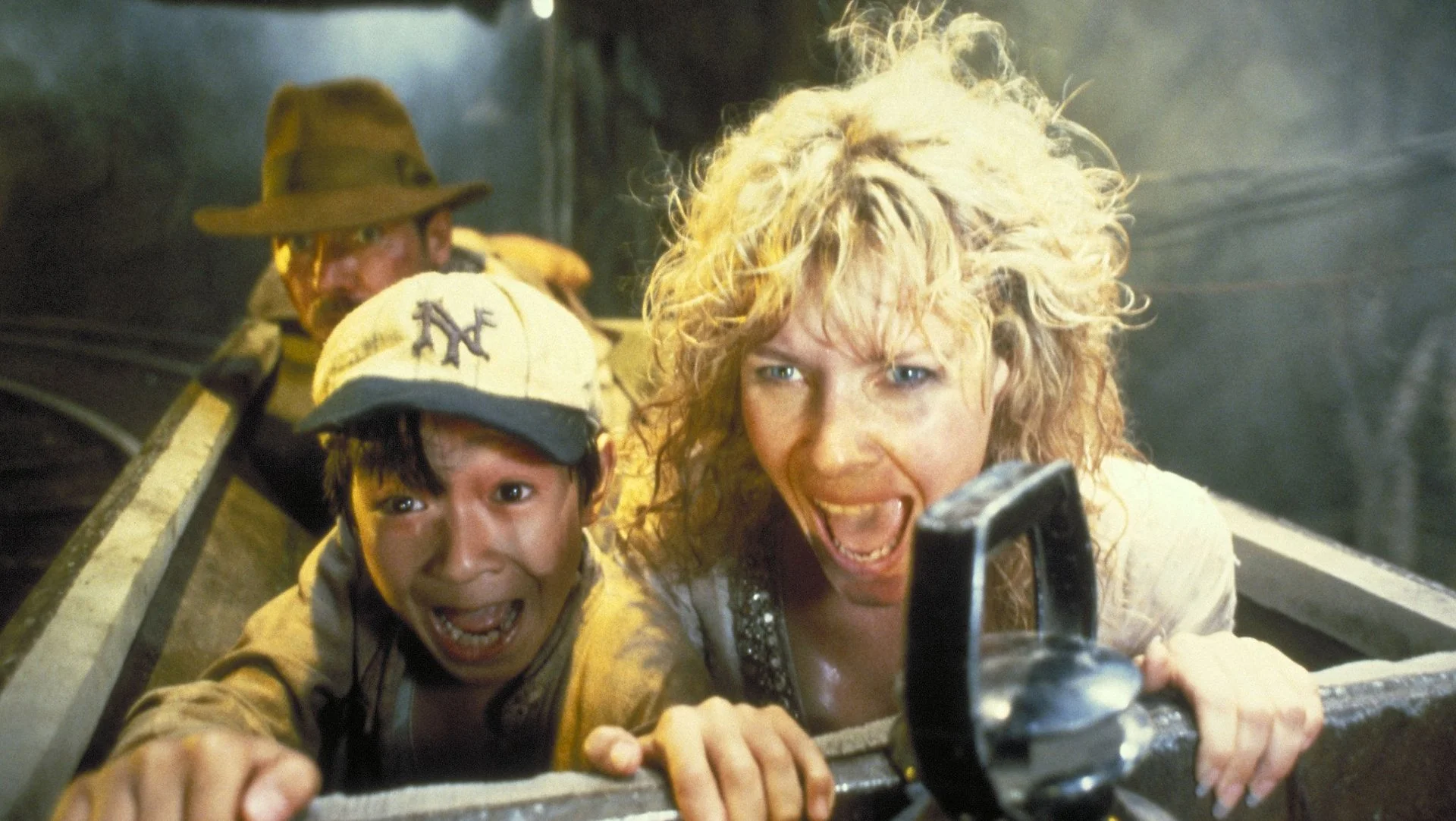
Even if Indy is more of a grave robber than an archaeologist in this film, and even if he is more focused on glory than goodness, he is not the bad guy here. But once he drinks the blood of Kali, he truly turns evil and briefly becomes a member of the Thuggee cult, falling into the “Black Sleep of Kali.” But the darkness can lead one to the light. Once he is awakened and returns to his normal self, he is a different person. His mission is no longer about chasing fortune and glory. When Willie tells Indy “Let’s get out of here,” his response is a bit different than before – “Right. All of us.” In the next scene, as a Thuggee guard abuses one of the children, a mine cart’s light slowly reveals Indiana in a classic close-up, in a hero’s pose and a scowl on his face. Cue the big fight scene, a crazy mine kart chase, and of course, the slave children’s escape to freedom.
Like Raiders, Indy embraces the spiritual truth of the relic by the end of the film. In his final fight with Mola Ram, he shouts “You betrayed Shiva,” demonstrating his respect for the stones’ power and the Hindu faith. “I understand it’s power now,” he tells the village priest when he successfully returns the stone.
But Indy doesn’t restore the village through this “magic rock” alone. I sometimes wonder – was it the rock that restored the village, or the return of the children that brings life back to their homes? As the rescued children are reunited with their mothers and fathers, the village is no longer a desolate and dark place but a joyous, vibrant home. In some ways, Indy has found a family himself, with Short Round as his sidekick and Willie Scott as a partner (for now at least). In a way, Temple of Doom begins Indiana Jones’ path towards his true family and is an interesting precursor to what comes next, beginning with his own reunion with his father in “The Last Crusade…”
A Father Sees the Light
A young Indiana Jones proudly scurries to his father, holding a sacred artifact that surely would win his approval. But his father is preoccupied with his work, pointing his finger and directing the future archaeologist to count to 10, in Greek. What should be a happy moment between father and son is lost; Henry Jones Sr. is lost himself – lost in his obsession over a lifelong, passionate search for the Holy Grail. He fails to notice young Indy backing away, and instead states, almost in a prayer, “May he who illuminated this, illuminate me.”
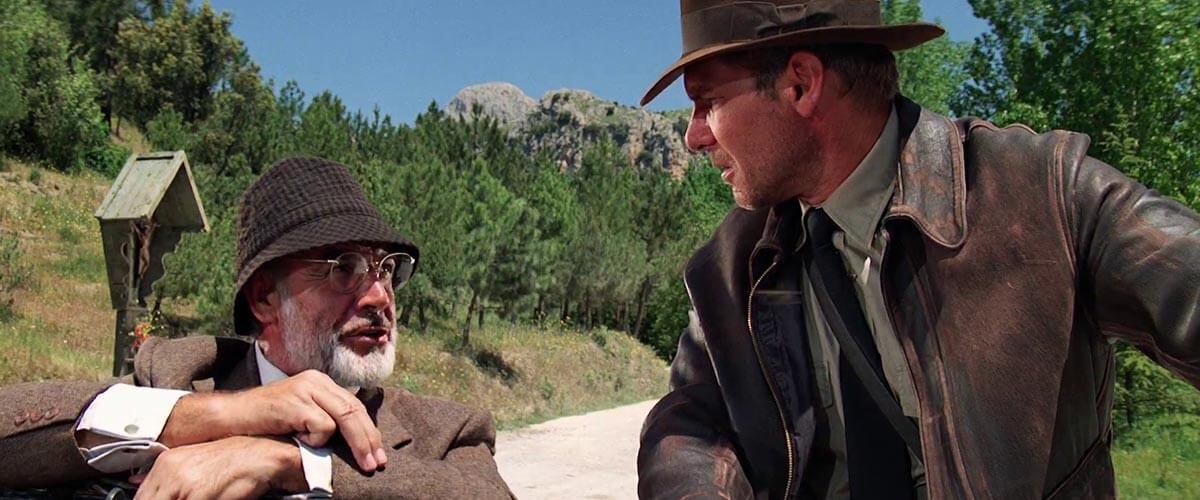
Last Crusade is a blast, to be sure, particularly when the “Jones boys” are reunited about a third of the way through the film. It adds a new dynamic to the series – a comic duo that provides some good natured, if somewhat goofy humor. But underneath is a story of a father and son divided, unable to connect despite their similarities. What the son feels as a rejection father sees as education, a lesson of “self-reliance.” But as Indy calls out, it was a lonely way to grow up, and a lonely way to live together.
After a thrilling motorcycle chase, a brief argument between the two opens up perhaps but has really divided them – the death of Indy’s mother. As they disagree over their next move to stay ahead of the Nazis, Indy declares “This is an obsession, Dad! I never understood it! Never! Neither did Mom.”
Henry Sr. disagrees, but then reveals a clue that suggests some guilt remains over the loss of his wife. “She kept her illness from me,” he claims, but perhaps deep down, he knows the truth. His search for the grail, his obsession, prevented him from seeing what was in front of him – a wife in failing health and a love lost. Once she passed, he delved more into his work than ever. But in doing so he left behind a son he was not able to console, a son he never really got to know.
Aboard a zeppelin, a quiet moment is available to father and son, and they open up slightly but still fail to connect, stubbornness and hesitancy preventing any sort of reconciliation. Only when facing death do the two recognize how much they mean to each other. When Indy is presumed dead after a spectacular tank chase against the Nazis, Henry Sr. is filled with grief. “I lost him, and I never told him anything,” he tells Marcus. “I just wasn’t ready. Five minutes would have been enough.” Ironic that he had ample time in the zeppelin scene mentioned above, but could not find the will.
But of course, there is a reason why Indiana Jones is Indiana Jones, somehow escaping death once again, to the utter joy of his father. He hugs him tightly, the first time we see any affection between the two, telling him “I thought I lost you, boy.” It’s a wonderful moment.
The quest is not complete, however, and as Indy is forced to recover the grail to save his father, the two become even more closely connected, simultaneously repeating the clues written in the grail diary – “Only the penitent man will pass, Only in the footsteps of God may he proceed, Only a leap from the lion’s head will he prove his worth.” It’s as if father and son now see though each other’s eyes, and by working together and understanding each other, they discover the Holy Grail.
But like all of Indy’s adventures, the journey was never about the artifact. As the cathedral begins to collapse, Indy is given a chance to obtain the Grail before it falls into the infinite depths below. But it is at too great a risk as his father tells him “Indiana, Let it go.” Sometimes you don’t need to search for all the answers. You cannot find peace and fulfillment solely by digging up objects from the past. Sometimes what you truly need is right in front of you. What Henry Sr. found was illumination, a long overdue connection with father and son so much more important than any prize.
As the credits roll, the Jones boys and team ride off into the sunset in what feels like a perfect ending. Alas, the box office always wins, and two more Indiana Jones adventures were thrust up on us. And the final two entries did not live up to their predecessors, both films have their moments. More importantly, Crystal Skull and Dial of Destiny stay true to the character of Indiana Jones and complete his journey in the pursuit of his own personal truth.
Returning Home
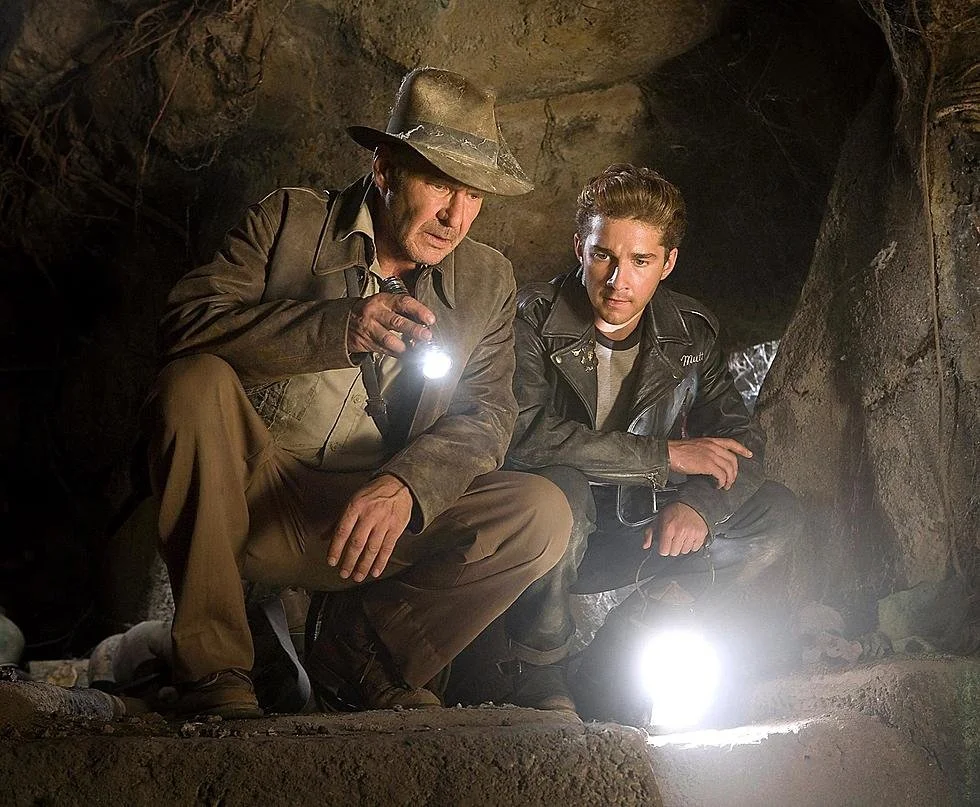
Let’s get this out of the way – Indiana Jones and the Kingdom of the Crystal Skull was a disappointment for me. That being said, there are some fun moments – Spielberg still delivers action scenes better than anyone, and it’s still a blast watching Harrison Ford fit almost perfectly back into this role. More to this discussion, the film continues the family theme that started in earnest with Temple of Doom, as Indy discovers a new purpose.
As the film begins, we find the famous professor at a crossroads. Accused of being a communist sympathizer, Indy is forced to take a leave of absence at his university. In a contemplative mood, he comments to his colleague about the loss of both Brody and his father over the past few years. “We seem to have reached the age where life stops giving us things and starts taking them away,” his old friend replies.
The reality is that life can take and give, no matter the age. In pursuit of the Crystal Skull, Indiana once again uncovers more than just an artifact. While there is less of a religious connection this time, the skull does have a unique power that installs a telekinetic connection with Indy midway through the film. That connection steers the film towards a new theme – “Return.” Indiana is driven to return the skull back to Akator, essentially returning the item “home” to it’s cosmic (or inter-dimensional, I guess) owners. At the same time as this connection forms, Indy discovers that life hasn’t stopped giving things after all. He is reunited with his Marion and discovers he is the father to Marion’s son Mutt. In a span of a few minutes after the Crystal Skull’s “connection,” Indy’s life has completely changed – he has his own family now, a home that he needs to “return” to as well.
The connection between Indy and the Crystal Skull does not end there. When he eventually returns the skull back to hidden city of Akator, Dr. Jones discovers a vast collection of artifacts resting inside the ancient hidden city. As he inspects these items, he comes to a surprising realization about the residents of the city (i.e. the aliens from another dimension). “They were archaeologists,” he states. Much like Indy, the aliens pursued knowledge, but a larger purpose now awaited them.
The skull theoretically provides ultimate knowledge, but much like in Raiders, one of this film’s lessons is that you cannot “cheat” your way into the universe’s secrets by opening a box, or, in this case, asking an alien. Knowledge must be earned, and as the Russian leaders learn this the hard way, Indiana and company (or should I say family) escape before the alien’s massive ship returns to the “space between spaces.”
The film closes with Indy still employed at Marshall College, no longer under a leave of absence. The film gives no real explanation as to how, but symbolically Indy’s professorial life has returned because he has accepted his new life as both husband and father. As he exits with his new bride, fate has given Indiana Jones a new life, a new family, and a new purpose.
But as much as life gives, life also takes, and in Indy’s final adventure he is forced to reckon with that fact as he comes to grips with a terrible loss, but ultimately finding redemption and peace.
Destiny and Purpose
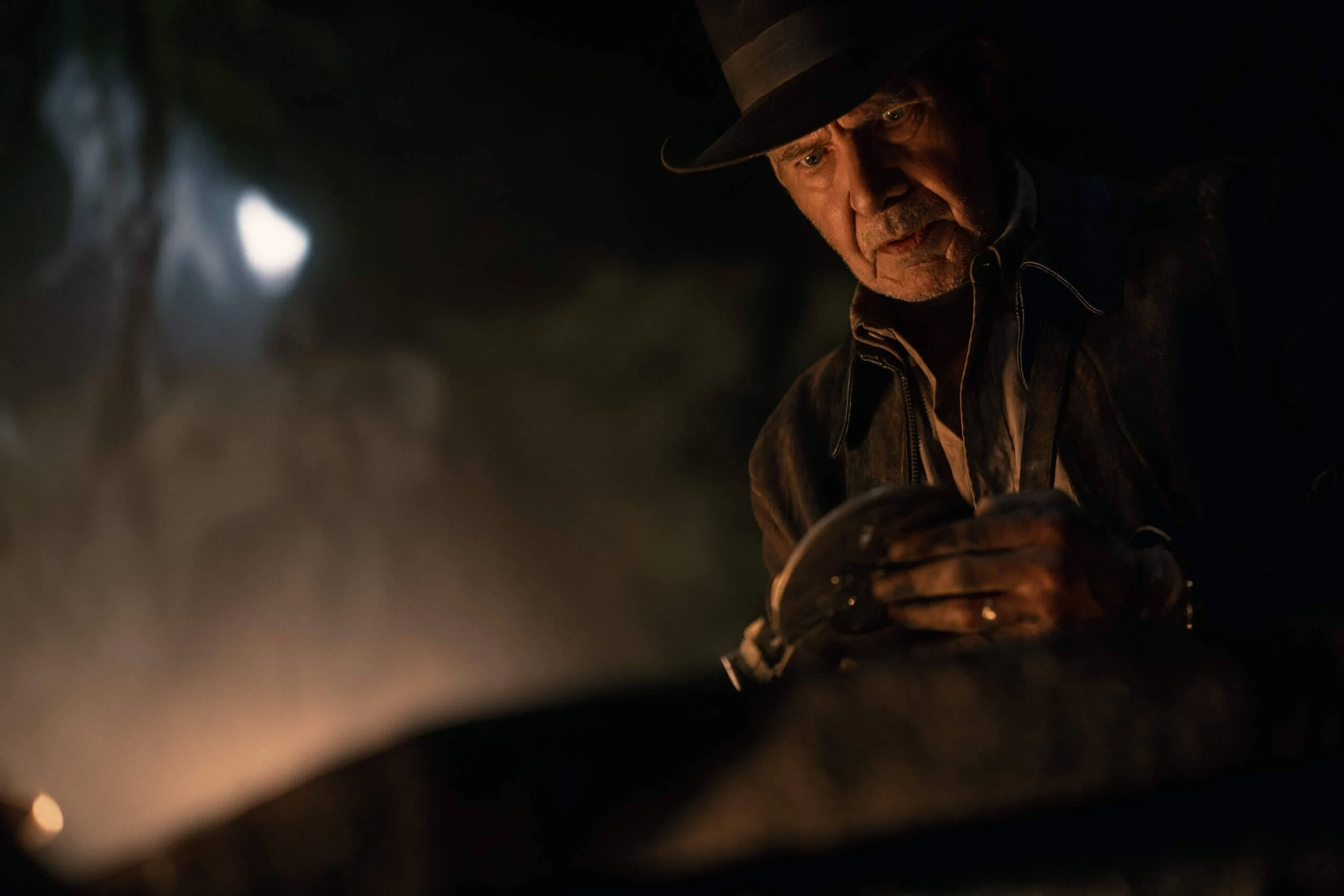
This may not be a popular opinion, but I think of Dial of Destiny works. It doesn’t reach the quality of the original three, but I think it’s a good Indiana Jones film. Director James Mangold can’t reproduce the Spielberg magic when delivering the action scenes (who can really?) but Dial of Destiny has a soul and purpose that I feel Crystal Skull lacked. Indiana has never been more vulnerable than in this film, and while that may have turned off some fans, that vulnerability provides a more personal and authentic view to the world’s greatest archaeologist and offers a conclusion that feels spiritually connected to the adventures that came before it.
After a fun blast from the past in 1944 Nazi Germany, we are introduced to a very different Indiana Jones 25 years later. Indy is a lost soul in 1969, out of his element in a time dominated by rock music and space races to the moon. At the same time, history has repeated itself. Indy is disconnected from Marian as he mourns the loss of their son (mirroring how Indy’s relationship with his father was disconnected).
Enter a new chance at adventure, and this time it’s a globe-trotting chase for the Antikythera, a relic from ancient Rome. A time manipulating device may seem like an out of place Macguffin for the Indiana Jones franchise, but the Antikythera in some ways is the perfect device to represent the end of the series. As Belloq tells Indy in Raiders, “Archaeology is our religion.” A device that can send one through time, to view the real history and truly witness what really happened, seems right up Indy’s alley. Indy’s connection to history is spiritual, his pursuit of facts his one consistent motivation. When the professor ponders “what physical irrefutable archaeological evidence” exists to prove what happened in Syracuse, Italy in 213 B.C. to his class, you can sense the passion he feels in the question and his pursuit of true history.
No one in the class feels that passion, of course. Noone, that is, except Helena Shaw, who turns out to be Indy’s goddaughter. “The Antikythera,” she replies. Helena very much resembles a young Indy in his Temple of Doom days, more driven by fortune and gloary than anything else. It makes for an interesting contrast, and as the two of them reconnect and join forces to obtain the missing piece of the Antikythera, she understands more of Indiana Jones the person more than the adventurer. As she learns about the loss of Indy’s son, killed in action in Vietnam, she discovers a man filled with pain and persistence, loss and regret.
If Indy’s only solace is his pursuit of validating history, then the Antikythera is his perfect tool, a method to go back in time and truly witness history. That’s exactly what it gives him, as the artifact provides a path to a fissure in time that puts them right in the middle of Syracuse, Italy, in 213 B.C. It’s his chance to be a part of history, to prove what really happened in the past, what he’s been searching for all his life. At his old age, and now with everything else seemingly gone – his son, his wife, and any family connection – his stubbornness to stay in history is almost understandable.
Fortunately, a wiser Helena, wiser in many respects because she sees life through Indy’s eyes, is the voice of reason. “His work is not done,” Helena shouts as he begs Archimedes, and to Indy, that he belongs in his own time. Indy truly has work be done within himself, to reconcile with his past and with Marion. Helena knocks some sense into Indy (literally), and Indy finds himself back home in 1969. For a moment, he questions his purpose, wondering who he is here for. Then Marion walks in the door. “Everything hurts,” he tell her, acknowledging the pain he is feeling but now willing to share it with her. The moment they reenact the classic “where doesn’t it hurt” scene from Raiders is not just fan service. It’s Indy’s truth moment – he realizes he can’t deal with this life, and this pain, alone. He needs Marion, and they need each other.
Indy’s close call of staying in the past, is, at least in my theory here, the summation of all of Indy’s adventures. Certainly archaeology and the study of the past are noble and important pursuits. But archaeology did not bring him closer to truth, his own personal truth. All of his adventures chasing archaeological relics, no matter how historically important, no matter how powerful, did nothing to change history. The Grail could never cross the Great Seal and was left behind. The Crystal Skull vanished to the space between spaces. The Antikythera was a “false deck.” The Sankara stones were lost save one, keeping alive a tiny village in India, unrevealed to the world. And the Ark of the Covenant, despite all of its power and mystery, was carted away in an unknown warehouse, disappearing into the vast stockpile of thousands of other relics, collecting dust, hidden from the rest of the world.
The truth Indy always needed was there from the very first film. All Indy has left at the end Raiders, after all the struggle, is Marion. “They don’t know what they got there,” he tells her, speaking of the Ark. Marion’s response is exactly what Indy needs to hear. “Well, I know what I got here.” Sometimes you don’t need to search for all the answers. You cannot find peace and fulfillment solely by digging up objects from the past. Sometimes what you truly need are the people beside you. Life’s greatest pursuits are not treasure, fortune, or glory. Life’s true adventure – family, loved ones, lasting relationships – is right in front of us.
